Understanding the Difference Between Static and Non-Static in Java
- Career Amend
- May 11
- 8 min read

Java is one of the most popular object-oriented programming languages, and understanding its core concepts is essential for writing efficient code. Among these concepts, static and non-static (instance) members play a crucial role in how Java programs are structured and executed.
Static and non-static elements define how variables and methods are accessed and stored in memory. While static members belong to the class itself, non-static members are tied to individual objects. This distinction affects performance, memory usage, and design decisions in real-world applications.
In this blog, we will explore the key differences between static and non-static in Java, supported by examples and best practices. Whether you are a beginner or an experienced developer, mastering this concept will improve your understanding of Java programming fundamentals.
What Does “Static” Mean in Java?
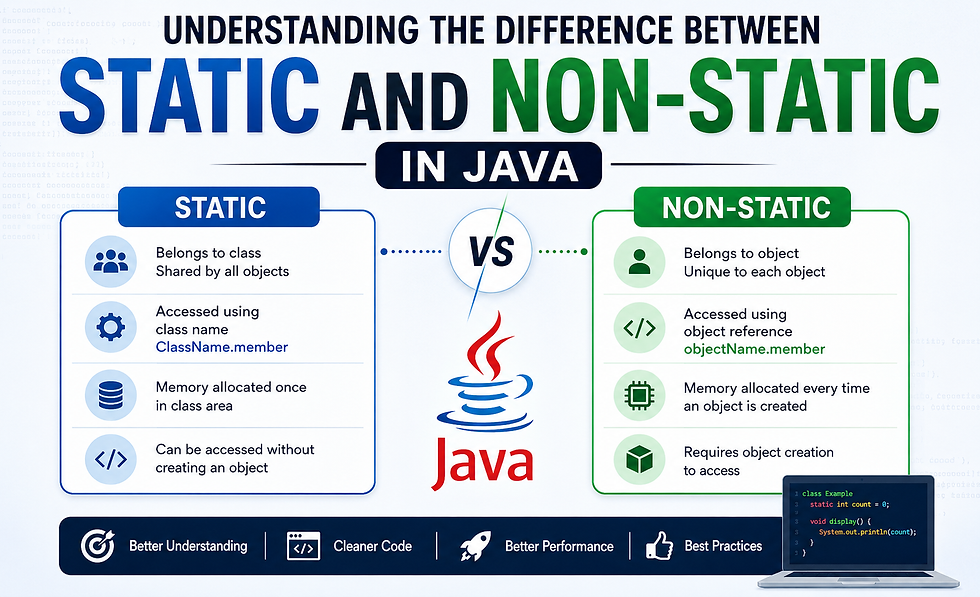
In Java, the keyword static is used to define members (variables, methods, blocks, or nested classes) that belong to the class rather than any specific instance of the class. This means that static members are shared across all objects of the class.
When a member is declared static, it is loaded into memory only once during class loading. You do not need to create an object to access static members. Instead, they can be accessed directly using the class name.
Example:
class Example {
static int count = 0;
}
Here, count is shared among all instances of the class.
Static members are commonly used for constants, utility methods, and shared resources. For example, the main() method in Java is static because it must be called without creating an object.
What Does “Non-Static” Mean in Java?
Non-static members, also known as instance members, are associated with individual objects of a class. Unlike static members, each object has its own copy of non-static variables.
To access non-static members, you must first create an instance (object) of the class. This allows each object to maintain its own state independently.
Example:
class Example {
int value = 10;
}
Here, each object of the class Example will have its own copy of value.
Non-static methods can access both static and non-static members, whereas static methods can only directly access static members. Instance members are essential for implementing object-oriented principles like encapsulation and data abstraction.
Key Differences Between Static and Non-Static (Quick Overview Table)
Understanding the differences between static and non-static members is crucial for writing efficient Java programs. Below is a quick comparison:
Feature | Static | Non-Static (Instance) |
Belongs to | Class | Object |
Memory Allocation | Once (Class Area) | Every Object |
Access | ClassName.member | ObjectName.member |
Requires Object? | No | Yes |
Shared Data | Yes | No |
Access to Members | Only static directly | Both static & non-static |
This table provides a clear overview, helping developers quickly decide which type to use based on their requirements.
Understanding Static Variables with Examples
Static variables are shared among all instances of a class, making them useful for representing common properties. They are initialized only once and retain their value across multiple objects.
Example:
class Counter {
static int count = 0;
Counter() {
count++;
System.out.println(count);
}
}
If you create multiple objects of Counter, the count variable will increment globally, not per object.
Output:
1
2
3
This demonstrates that static variables maintain a single shared value. They are ideal for scenarios like counting objects, storing configuration values, or defining constants using the final keyword.
Understanding Non-Static (Instance) Variables with Examples
Non-static variables are unique to each object and are essential for representing object-specific data. Each time a new object is created, a fresh copy of instance variables is allocated in memory.
Example:
class Student {
String name;
Student(String name) {
this.name = name;
}
}
Here, every Student object will have its own name.
Usage:
Student s1 = new Student("Alice");
Student s2 = new Student("Bob");
Instance variables are fundamental to object-oriented programming because they allow objects to have unique states and behaviors, making programs more flexible and reusable.
Static Methods Explained with Code Examples
Static methods belong to the class rather than any object. They can be called directly using the class name without creating an instance. These methods can only access static variables and other static methods directly.
Example:
class Utility {
static void displayMessage() {
System.out.println("Hello from static method!");
}
}
Usage:
Utility.displayMessage();
Static methods are widely used for utility or helper functions, such as mathematical operations or conversions. For example, methods in the Math class like Math.sqrt() are static.
One key limitation is that static methods cannot directly access instance variables because they do not belong to any object.
Non-Static Methods Explained with Code Examples
Non-static methods, also known as instance methods, require an object to be invoked. These methods can access both static and non-static members of a class.
Example:
class Person {
String name;
void displayName() {
System.out.println(name);
}
}
Usage:
Person p = new Person();
p.name = "John";
p.displayName();
Instance methods are essential for defining behaviors that depend on object data. They allow each object to perform actions based on its unique state.
Unlike static methods, instance methods support dynamic behavior and polymorphism, making them a core part of object-oriented programming.
Memory Allocation: Static vs Non-Static in Java
Memory management is a key factor that differentiates static and non-static members in Java. Static members are stored in the method area (or class area), while non-static members are stored in the heap memory as part of objects.
Static variables are allocated once when the class is loaded, which reduces memory usage when multiple objects are created. In contrast, instance variables are allocated separately for each object, increasing memory consumption.
This difference has a direct impact on performance and scalability. Static members are efficient for shared data, while non-static members are necessary for object-specific data.
Understanding memory allocation helps developers design efficient applications and avoid unnecessary resource usage.
When to Use Static in Java (Best Practices)
Using static members correctly can improve performance and simplify code. However, misuse can lead to design issues and reduced flexibility.
Use static when:
You need a common value shared across all objects
You are creating utility or helper methods
You want to define constants using static final
The method does not depend on instance variables
Example:
class Constants {
static final double PI = 3.14159;
}
Best Practices:
Avoid excessive use of static variables
Do not use static for object-specific data
Prefer static methods for stateless operations
Keep static usage aligned with object-oriented principles
By following these practices, you can ensure that your Java code remains clean, efficient, and maintainable.
When to Use Non-Static in Java (Best Practices)
Non-static members should be used when your application requires object-specific behavior or data. Since each instance of a class has its own copy of non-static variables, they are ideal for representing unique properties.
Use non-static when:
Data differs for each object
You need to model real-world entities
Methods depend on instance variables
You want to leverage object-oriented features like inheritance and polymorphism
Best Practices:
Use instance variables for object-specific data
Avoid unnecessary object creation if data can be shared
Keep methods non-static when behavior depends on object state
Using non-static members appropriately ensures better flexibility, scalability, and adherence to object-oriented design principles.
Accessing Static vs Non-Static Members in Java
Accessing static and non-static members in Java follows different approaches. Static members are accessed using the class name, while non-static members require object creation.
Static Access:
ClassName.staticVariable;
ClassName.staticMethod();
Non-Static Access:
ClassName obj = new ClassName();
obj.instanceVariable;
obj.instanceMethod();
Static members can also be accessed using objects, but it is not recommended as it reduces code clarity.
Understanding the correct way to access members helps prevent errors such as NullPointerException and improves code readability.
Static Block in Java: Concept and Use Cases
A static block in Java is used for static initialization of a class. It is executed only once when the class is loaded into memory, before the main method is called.
Example:
class Example {
static {
System.out.println("Static block executed");
}
}
Static blocks are useful when you need to perform complex initialization tasks that cannot be handled in a single line.
Use Cases:
Initializing static variables
Loading configuration files
Setting up database connections (in some cases)
Static blocks improve efficiency by ensuring initialization happens only once.
Real-World Examples of Static vs Non-Static
Understanding real-world applications makes it easier to grasp the difference between static and non-static members.
Static Example:
A company-wide policy (e.g., company name) remains the same for all employees. This can be represented using a static variable.
Non-Static Example:
Employee details such as name, ID, and salary vary for each employee. These should be non-static.
Code Illustration:
class Employee {
static String company = "TechCorp";
String name;
Employee(String name) {
this.name = name;
}
}
Here, company is shared, while name is unique.
This approach mirrors real-world scenarios and helps in designing scalable applications.
Common Mistakes Developers Make
Many developers, especially beginners, make mistakes when working with static and non-static members.
Common Errors:
Accessing non-static variables from static methods directly
Overusing static variables, leading to poor design
Misunderstanding memory allocation
Using static where instance behavior is required
Example Mistake:
class Test {
int x = 10;
static void display() {
System.out.println(x); // Error
}
}
Solution:
Make x static or create an object.
Avoiding these mistakes improves code quality and prevents runtime or compile-time errors.
Static vs Non-Static in Object-Oriented Programming Context
In object-oriented programming (OOP), static and non-static members serve different purposes.
Static members are not tied to objects and do not support polymorphism or inheritance in the same way instance members do. They are mainly used for utility functions and shared data.
Non-static members, on the other hand, are central to OOP concepts like encapsulation, inheritance, and polymorphism. They allow objects to behave differently based on their state.
Understanding this distinction helps developers design better object-oriented systems and maintain clean architecture.
Performance Considerations: Static vs Instance Members
Performance is an important factor when choosing between static and non-static members.
Static members are generally faster because they are loaded once and shared across all objects. This reduces memory overhead and improves efficiency.
Instance members, while slightly heavier in memory usage, provide flexibility and are necessary for object-specific logic.
Key Takeaways:
Use static for shared, frequently accessed data
Use non-static for dynamic, object-specific behavior
Balance performance with design principles
Optimizing the use of static and instance members leads to better-performing applications.
Advantages and Disadvantages of Static Members
Advantages:
Memory efficient (single copy shared)
Faster access
Useful for constants and utility methods
No need for object creation
Disadvantages:
Cannot access instance members directly
Reduces flexibility
Not suitable for object-specific data
Can lead to poor design if overused
Static members are powerful but should be used carefully to avoid tight coupling and maintainability issues.
Advantages and Disadvantages of Non-Static Members
Advantages:
Supports object-oriented principles
Allows unique object states
Enables polymorphism and inheritance
More flexible and reusable
Disadvantages:
Higher memory usage
Requires object creation
Slightly slower compared to static members
Non-static members are essential for building real-world applications where each object represents a unique entity.
Conclusion:
Choosing between static and non-static in Java depends on your application requirements. If you need shared data or utility functionality, static is the right choice. If your program relies on object-specific behavior, non-static members are essential.
A balanced approach is key. Overusing static can make your code rigid, while excessive use of instance members can increase memory usage unnecessarily.
By understanding their differences, use cases, and best practices, you can write efficient, scalable, and maintainable Java applications.
Read More: What is StringBuilder in Java?
Read More: Java String vs StringBuilder
Read More: How to Become an Ethical Hacker
Read More : Types of Data
Read More: Types of Data Analytics
Read More: Data Analyst Skills
Read More: Ethical Hacking Course Syllabus


Comments