Business Analyst vs. Data Scientist: Education, Skills & Salary Compared

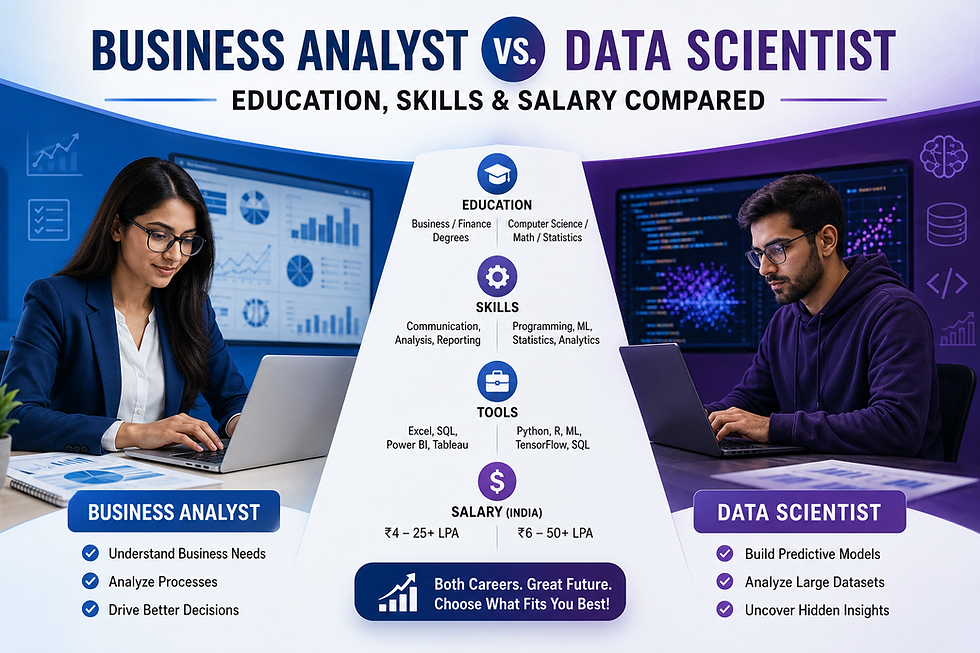
In today’s data-driven world, careers in analytics are growing rapidly. Two of the most popular roles are Business Analyst vs Data Scientist. While both deal with data, their responsibilities, required skills, and career paths differ significantly. If you're confused about which career to choose, this detailed comparison will help you make the right decision.
What Is a Business Analyst?
A Business Analyst (BA) focuses on bridging the gap between business needs and technology solutions. They analyze business processes, identify problems, and recommend data-driven strategies to improve efficiency and profitability.
Business Analysts work closely with stakeholders, gather requirements, and ensure that solutions align with business goals. Their primary focus is on decision-making rather than deep technical analysis.
What Is a Data Scientist?
A Data Scientist is a highly technical professional who works with large datasets to uncover insights, build predictive models, and solve complex problems using statistical and machine learning techniques.
They use programming, algorithms, and data modeling to predict future trends and automate decision-making
processes. Data Scientists are more focused on advanced analytics and data engineering.
Key Differences Between Business Analyst and Data Scientist
Aspect | Business Analyst | Data Scientist |
Focus | Business insights & strategy | Data modeling & predictions |
Technical Skills | Moderate | Advanced |
Tools | Excel, SQL, Power BI | Python, R, Machine Learning |
Role Type | Business-oriented | Technical & analytical |
Goal | Improve processes | Predict and optimize outcomes |
Educational Requirements
Business Analyst Education
To become a Business Analyst, you typically need:
Bachelor’s degree in Business Administration, Finance, or Economics
MBA (optional but beneficial)
Certifications like CBAP or PMI-PBA
A technical background is helpful but not mandatory.
Data Scientist Education
A Data Scientist usually requires:
Bachelor’s degree in Computer Science, Mathematics, or Statistics
Master’s degree or specialization (highly preferred)
Knowledge of Machine Learning, AI, and Data Engineering
A strong foundation in mathematics and programming is essential.
Skills Comparison
Business Analyst Skills
Strong communication and presentation skills
Business process analysis
Requirement gathering
Data visualization (Power BI, Tableau)
Basic SQL and Excel
Problem-solving mindset
Data Scientist Skills
Programming (Python, R)
Machine Learning & AI
Statistical analysis
Data cleaning and preprocessing
Big Data tools (Hadoop, Spark)
Deep learning (optional but valuable)
Tools Used
Business Analyst Tools
Microsoft Excel
Power BI / Tableau
SQL
JIRA / Confluence
Data Scientist Tools
Python (Pandas, NumPy, Scikit-learn)
R Programming
TensorFlow / PyTorch
SQL & NoSQL databases
Jupyter Notebook
Salary Comparison
Business Analyst Salary
Entry-level: ₹4–8 LPA
Mid-level: ₹8–15 LPA
Senior-level: ₹15–25+ LPA
Data Scientist Salary
Entry-level: ₹6–12 LPA
Mid-level: ₹12–25 LPA
Senior-level: ₹25–50+ LPA
Data Scientists generally earn more due to their advanced technical expertise and high demand.
Career Growth Opportunities
Business Analyst Career Path
Junior Business Analyst
Senior Business Analyst
Product Manager
Business Consultant
Business Analysts often move into managerial or strategic roles.
Data Scientist Career Path
Data Analyst → Data Scientist
Senior Data Scientist
Machine Learning Engineer
AI Specialist
Data Scientists can transition into advanced AI and research roles.
Which Career Should You Choose?
Choose Business Analyst if:
You enjoy working with business strategies
You have strong communication skills
You prefer less coding and more decision-making
Choose Data Scientist if:
You love coding and mathematics
You enjoy working with large datasets
You want a high-paying, technical career
Advantages and Disadvantages
Business Analyst Pros
Easier entry compared to Data Science
Less technical complexity
Strong career in management
Business Analyst Cons
Lower salary compared to Data Scientists
Limited technical exposure
Data Scientist Pros
High salary and demand
Cutting-edge technology exposure
Strong career growth
Data Scientist Cons
Requires strong technical skills
Steeper learning curve
Final Thoughts
Both Business Analyst and Data Scientist are excellent career options with strong demand in the job market. Your choice should depend on your interests, strengths, and career goals.
If you enjoy business strategy and communication, Business Analysis is ideal. If you’re passionate about coding, statistics, and AI, Data Science is the better path.
FAQs
1. Is Data Scientist better than Business Analyst?
Not necessarily. Data Scientists earn more, but Business Analysts have strong roles in strategy and management.
2. Can a Business Analyst become a Data Scientist?
Yes, by learning programming, statistics, and machine learning.
3. Which role has more job opportunities?
Both roles are in demand, but Data Science is growing faster.
4. Do Business Analysts need coding skills?
Basic SQL and Excel are enough; advanced coding is not required.
5. Is Data Science hard to learn?
It can be challenging due to math and programming, but it’s achievable with consistent practice.


Comments