Benefits of Generative AI in Data Analysis and Decision-Making

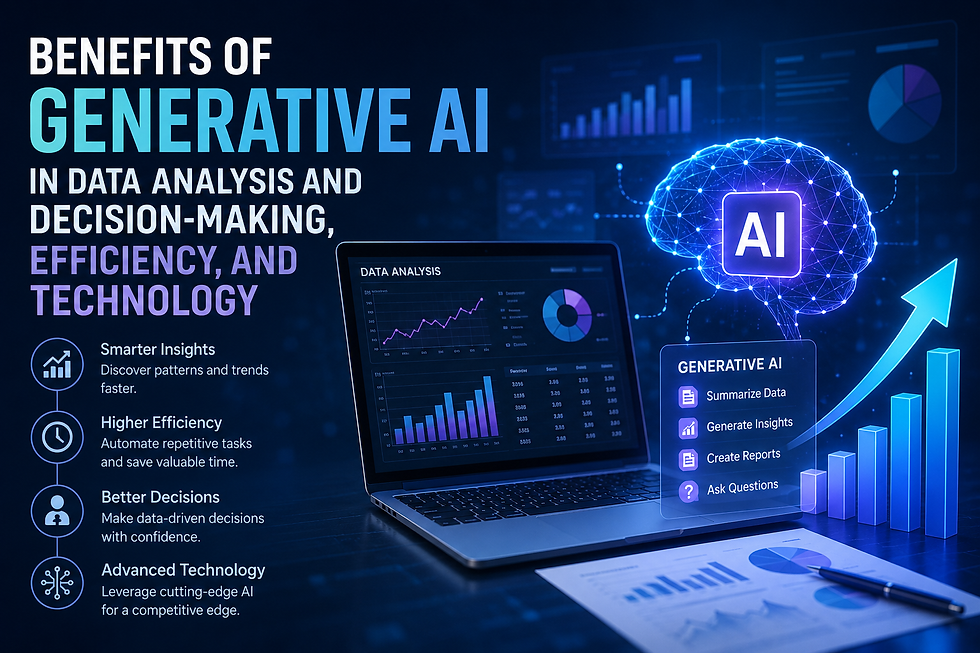
Generative AI is transforming how businesses analyze data, identify patterns, and make informed decisions. By combining natural language processing, machine learning, and automation, generative AI can help organizations turn complex datasets into understandable insights.
The Benefits of Generative AI extend beyond content creation. In data analysis, it can accelerate reporting, identify trends, summarize information, generate analytical queries, and support decision-making. As businesses produce larger volumes of data, these capabilities can improve efficiency while allowing teams to focus more on strategy and problem-solving.
What Is Generative AI?
Generative AI refers to artificial intelligence systems capable of creating new content based on patterns learned from existing data. It can generate text, code, summaries, explanations, and other outputs.
In data analysis, generative AI can interact with information using natural language. Instead of writing complex queries manually, users can ask questions in everyday language and receive explanations or analytical outputs. This makes data more accessible to professionals who may not have advanced technical skills.
How Generative AI Supports Data Analysis
Generative AI can assist analysts throughout the data analysis process. It can help prepare questions, organize information, generate queries, summarize findings, and explain complicated results.
For example, an analyst could ask an AI system to identify sales trends from a dataset. The system may highlight changes across products, regions, or time periods and present the findings in an easier-to-understand format.
These capabilities can reduce repetitive work and help analysts spend more time interpreting results and developing business strategies.
Faster Data Processing and Analysis
One of the major benefits of Generative AI is its ability to accelerate analytical workflows. Traditional analysis can involve multiple manual steps, including preparing queries, organizing data, creating summaries, and developing reports.
Generative AI can assist with several of these tasks, helping teams move from raw information to preliminary insights more quickly.
Faster processing does not eliminate the need for human review. Instead, it can provide analysts with a starting point that they can validate, refine, and use for deeper investigation.
Automated Data Summarization
Large datasets can contain thousands or millions of records, making manual review difficult. Generative AI can summarize analytical results into concise explanations.
For example, a business may use AI to summarize monthly sales performance, identify significant changes, and describe important trends. Executives can then review key findings without going through every underlying data point.
Automated summaries can save time and improve communication between technical teams and business decision-makers.
Natural Language Data Queries
Generative AI allows users to interact with data using natural language. Instead of manually writing SQL queries or complex formulas, users can describe what they want to know.
For example, a manager could ask, “Which product category had the highest sales growth this quarter?” An AI-powered analytics system may translate the request into an appropriate query and provide an explanation.
This makes data analysis more approachable for non-technical users while still allowing experienced analysts to work more efficiently.
Improved Decision-Making
Data-driven decisions depend on accurate and timely information. Generative AI can support decision-making by organizing relevant information and presenting patterns in a readable format.
Businesses can use AI-generated summaries to examine sales performance, customer behavior, operational metrics, and market information.
The technology should support rather than replace human judgment. Decision-makers should verify important findings against reliable source data before making high-impact business decisions.
Identifying Trends and Patterns
Generative AI can help analysts identify meaningful patterns within large datasets. It can assist in recognizing relationships, unusual changes, and recurring trends that deserve further investigation.
For example, an organization analyzing customer data might discover changes in purchasing behavior across different periods or customer groups.
AI-generated observations can provide useful starting points for analysts, who can then investigate whether the patterns are statistically meaningful and relevant to the business.
Reducing Repetitive Analytical Tasks
Data professionals often spend significant time performing repetitive activities such as generating reports, writing queries, documenting findings, and preparing summaries.
Generative AI can automate or assist with many of these tasks. This can reduce manual workload and allow analysts to dedicate more time to complex analysis, business interpretation, and strategic planning.
The result can be a more efficient workflow where AI handles routine assistance while people remain responsible for validation and final decisions.
Generating Data Analysis Reports
Creating analytical reports can require considerable time, particularly when information must be collected from multiple sources. Generative AI can help create report drafts from structured data and analytical results.
It can organize findings into sections, explain important changes, and create executive summaries.
Analysts can review the generated report, correct errors, add context, and ensure that conclusions are supported by the underlying data. This human review is important because AI-generated content can contain inaccuracies.
Improving Business Efficiency
Efficiency is another important area where the benefits of Generative AI can become visible. By assisting with repetitive analysis and reporting tasks, AI can shorten certain workflows and reduce manual effort.
Organizations can potentially use saved time for strategic activities such as customer research, product development, forecasting, and process improvement.
However, efficiency gains depend on factors such as data quality, system integration, employee skills, and appropriate implementation.
Better Data Visualization Support
Generative AI can assist users in deciding how data should be presented. Based on the analytical question, it may suggest suitable charts, tables, or dashboard structures.
For example, time-based trends may be better represented through line charts, while comparisons between categories may benefit from bar charts.
AI can also explain what a visualization represents in natural language, helping non-technical users understand analytical results more easily.
Supporting Predictive Analysis
Generative AI can complement predictive analytics by helping users interpret forecasts and model outputs. It can explain expected trends, summarize model results, and assist users in exploring different scenarios.
For example, a business could examine potential changes in demand under different assumptions.
Generative AI does not automatically make predictions accurate. Forecast quality depends on the underlying data, analytical methods, assumptions, and model design. Human experts should validate important predictive results before using them for major decisions.
Enhanced Customer Insights
Customer data provides valuable information about preferences, purchasing behavior, feedback, and engagement. Generative AI can help summarize this information and identify themes within large amounts of customer feedback.
Businesses can use these insights to understand common customer concerns and identify areas for improvement.
For example, AI can organize thousands of customer comments into themes such as product quality, delivery, pricing, or customer service, helping teams focus their attention on recurring issues.
Faster Market and Business Research
Generative AI can help organize and summarize information used during business research. Analysts can use AI tools to structure research questions, summarize provided documents, and compare information from approved sources.
This can reduce the time required to prepare preliminary research.
However, AI-generated research should be checked against trustworthy sources because generative systems can produce incorrect or outdated information. Verification remains essential when research influences business decisions.
Improving Collaboration Between Teams
Generative AI can make analytical findings easier to communicate across departments. Technical analysts may produce complex results, while marketing, finance, operations, and management teams may need simpler explanations.
AI can help translate technical findings into plain-language summaries.
This can improve communication and help different teams understand the same dataset from their own business perspective. Better communication can support collaboration when teams are working toward shared objectives.
Personalized Insights for Decision-Makers
Different employees may need different information from the same dataset. A financial manager may focus on costs and profitability, while a marketing manager may focus on customer acquisition and campaign performance.
Generative AI can help create role-specific summaries based on the same underlying information.
This can make large datasets easier to navigate and allow decision-makers to focus on metrics most relevant to their responsibilities.
Generative AI and Technology Efficiency
Generative AI is becoming an important component of modern technology environments. When integrated with analytics platforms, databases, business intelligence tools, and enterprise applications, it can create more conversational and automated workflows.
Users may interact with analytical systems through natural-language prompts rather than navigating complex interfaces.
These capabilities can improve accessibility and potentially reduce the time required to complete common analytical tasks.
Data Quality and Validation Challenges
Despite the many benefits of Generative AI, organizations must consider data quality carefully. AI systems can generate incorrect interpretations when datasets are incomplete, inconsistent, outdated, or poorly structured.
Businesses should establish data-quality processes and validation procedures before relying on AI-generated insights.
Important decisions should be supported by verified source data, appropriate analytical methods, and human review rather than relying solely on AI-generated outputs.
Security and Privacy Considerations
Data analysis often involves sensitive business or customer information. Organizations should carefully consider how data is processed by generative AI systems.
Appropriate security controls, access management, data governance, and privacy policies should be established before integrating AI into analytical workflows.
Companies should also understand how their chosen AI platform handles submitted information and ensure that its use complies with applicable organizational and legal requirements.
The Future of Generative AI in Data Analysis
The role of generative AI in data analysis is likely to continue developing as AI models, analytics platforms, and enterprise technologies improve.
Future systems may provide more conversational analytics, automated reporting, intelligent data exploration, and stronger integration with business applications.
Organizations that adopt these technologies will still need skilled professionals to validate results, understand business context, manage data, and make responsible decisions. The future is likely to involve collaboration between human expertise and AI-powered analytical tools.
Conclusion:
The Benefits of Generative AI in data analysis and decision-making include faster workflows, automated summaries, natural-language queries, improved reporting, pattern identification, and easier access to complex information.
Generative AI can improve efficiency and support technology-driven decision-making, but it should not be treated as an unquestionable source of truth. Data quality, security, privacy, accuracy, and human validation remain essential.
When implemented responsibly, generative AI can become a valuable assistant for analysts, managers, and organizations seeking to turn data into actionable business insights.


Comments